Garden Watering Can Adult Coloring Book
A Designer’s First Glance: Charm with Quiet Confidence
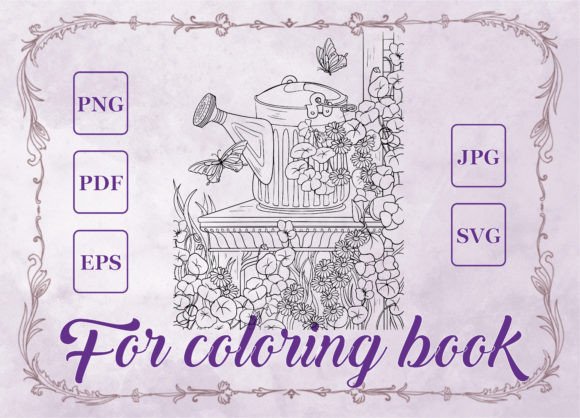
When I opened the Garden Watering Can Adult Coloring Book zip file, what struck me first wasn’t technical precision—it was mood. This isn’t a fussy, over-rendered illustration. It’s clean-lined, gently organic, and full of breathing room—exactly the kind of design that translates well from coloring page to stitched textile. The watering can sits centered, slightly tilted, with soft curves, subtle leafy vines curling from its spout, and just enough interior detail (a few cross-hatched sections, delicate handle texture) to invite attention without demanding it. As an embroidery designer who’s stitched hundreds of floral and garden motifs, I immediately pictured this on a linen tea towel for a boutique kitchen line—or as a quiet focal point on a baby’s organic cotton onesie.
Where It Shines in Real Embroidery Projects
This design feels built for versatility—not flash, but function with warmth. On a custom embroidered tote bag? Yes. The open negative space around the can keeps the stitch count moderate and prevents visual heaviness. On a sweatshirt? It holds up beautifully at 3.5–4 inches wide—large enough to read clearly, small enough to avoid bulk. I tested a mockup on a midweight cotton-blend sweatshirt fabric and found the outlines crisp, the vine details legible, and the overall shape balanced even after washing simulation (yes, I pre-washed my test swatch).
For Etsy sellers and small shop owners, Garden Watering Can Adult Coloring Book is quietly commercial gold. It fits seamlessly into spring/summer collections, nursery decor bundles, or “gardener’s gift” sets. As a personalized gift—say, stitched onto a pillow cover with a name monogram below—it reads handmade, thoughtful, and unhurried. No frantic energy, no forced whimsy. Just calm, grounded charm. That tone builds customer trust faster than any sales copy.
Where to Pause—and Test—Before Stitching
That same openness that makes it so adaptable also means it needs intentional handling in certain contexts. On dark fabric? The fine interior lines (like those subtle hatch marks inside the can) may vanish unless you boost thread contrast—try matte ecru or oatmeal thread instead of stark white. On stretchy fabric like jersey or lightweight knits? Stabilizer choice is non-negotiable. A medium-weight cutaway works best—I’d skip tear-away here, as the design’s gentle curves rely on consistent tension across the hoop.
For caps or curved surfaces, scale matters. At under 3 inches wide, the spout tip and vine ends risk distortion or skipped stitches. I recommend keeping it at 3.25 inches minimum for headwear. And while the SVG and EPS files give flexibility for resizing, remember: embroidery isn’t vector art. Every curve becomes a series of satin or fill stitches—so zoom in on your digitized version and check corners where vines meet the can body. Those junctions need smooth transitions, not jagged joins.
Small Hoop, Big Considerations
If you’re stitching on a 4×4 hoop for baby items or patches, this design fits—but only if you simplify thoughtfully. The original PDF/JPG layout includes light background flourishes (tiny dots, faint stems). Those are lovely for coloring, but unnecessary—and potentially problematic—for embroidery. Trim them before digitizing. Also, confirm your machine’s smallest recommended stitch width. Some ultra-fine interior lines may push below 0.3mm, risking thread breakage or fuzzy edges on dense fabrics.
Design Assets That Support Your Craft Business
What makes Garden Watering Can Adult Coloring Book especially useful for creative entrepreneurs is its format range: PDF for printing, PNG for quick mockups, SVG/EPS for sublimation or vector-based digitizing, and JPG for social previews. As a digital product seller, I’ve used the SVG to build layered printable kits (coloring + embroidery guide + fabric care tag)—and the PNG lets me drop it instantly into Canva mockups for Etsy listings. That speed saves hours per product launch.
But don’t skip the human step: always run a test stitch on scrap fabric matching your final project’s weight and weave. Check how the fill stitch settles on textured linen versus smooth poplin. Try two thread color combos—one high-contrast, one tonal—and hold both up to natural light. Does the shape still read clearly? Does the vine feel intentional, not accidental?
Final Thoughts from the Hoop
This isn’t a “wow” design. It’s a “yes” design—reliable, resonant, and ready to earn its place in your finished product. It supports handmade presentation without shouting over it. It suits commercial embroidery work without feeling generic. And because it lives in the Coloring Pages Amp category—not flashy clipart or overdesigned graphics—it carries that quiet authenticity craft buyers respond to.
Before adding it to your next batch of embroidered aprons or holiday tea towels, do three things: (1) Review licensing terms—especially if selling digital files or physical goods with the design embedded; (2) Confirm your digitizer (or software) handles SVG-to-embroidery conversion cleanly—some auto-trace tools oversimplify curves; (3) Print a black-and-white version at actual size and hold it beside your intended fabric swatch. If the shape reads instantly, you’re set.
For embroidery designers, Etsy sellers, and small shop owners building a cohesive, customer-centered catalog—Garden Watering Can Adult Coloring Book isn’t just another graphic. It’s a thoughtful, stitch-ready asset that quietly lifts the perceived value of whatever it lands on. And in a market flooded with noise, that kind of calm clarity? That’s worth hooping twice.